
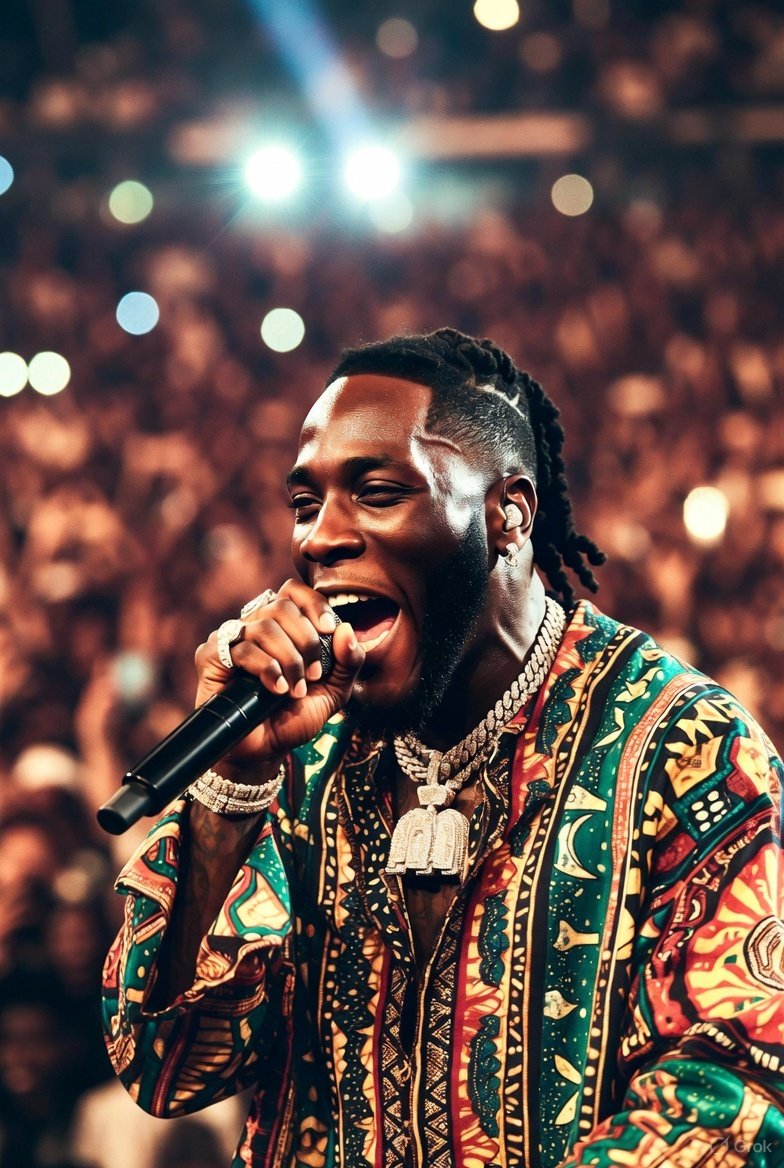
Port Harcourt, Nigeria — When Damini Ebunoluwa Ogulu, better known as Burna Boy, stepped onto the stage at Madison Square Garden in 2022, he wasn’t just performing. He was making history: the first Nigerian artist to headline and sell out the iconic New York venue. For many, it was the culmination of a decade-long ascent that has transformed him from a local talent into one of Africa’s most powerful cultural exports.
From Port Harcourt to the World
Born on July 2, 1991, Burna Boy grew up in a household where music was more than background noise. His grandfather, Benson Idonije, once managed Afrobeat pioneer Fela Kuti, and his mother, Bosede Ogulu, later became his manager. That lineage, combined with exposure to reggae legends like Bob Marley and the infectious pulse of dancehall, shaped the eclectic sound that would become his signature.
After attending Corona Secondary School in Lagos, Burna Boy moved to the United Kingdom to study media technology. But academia couldn’t compete with his passion for music. By 2010, he had returned to Nigeria, determined to carve out a career in an industry that was beginning to attract global attention.
Breaking Through
His debut mixtape Burn Notice (2011) hinted at promise, but it was the 2012 single “Like to Party” that changed everything. The track, part of his debut album L.I.F.E – Leaving an Impact for Eternity, became a nationwide hit and earned him nominations at major Nigerian award shows.
Subsequent albums, including On a Spaceship (2015) and Outside (2018), expanded his reach. Collaborations with Western artists like Lily Allen introduced him to new audiences, while the breakout anthem “Ye” resonated across the African diaspora, blending pidgin English with infectious beats.
The African Giant Era
By 2019, Burna Boy was ready to stake his claim on the global stage. His fourth studio album, African Giant, was both a musical triumph and a political statement. Featuring collaborations with Future, Jorja Smith, and Damian Marley, the album earned him his first Grammy nomination. Songs like “Anybody” and “On the Low” dominated charts, while his lyrics tackled colonialism, corruption, and African unity — themes that echoed Fela Kuti’s activism.
Global Recognition
The momentum carried into the 2020s. In 2021, Burna Boy won his first Grammy for Twice as Tall, executive-produced by Diddy, becoming the first Nigerian artist to win in the Best Global Music Album category. A year later, he sold out Madison Square Garden, cementing his reputation as a global star.
His 2022 album Love, Damini and 2023’s I Told Them… kept him in the spotlight, with singles like “Last Last” going viral on TikTok. Along the way, he performed at Coachella and Glastonbury, collaborated with Beyoncé on The Lion King: The Gift, and continued to headline festivals worldwide.
Legacy in Motion
Today, Burna Boy’s influence extends beyond music. His outspoken critiques of Nigerian politics, including support for the #EndSARS movement, have positioned him as both an entertainer and a social commentator. His success story reflects a broader trend: the rise of Afrobeats as a global phenomenon, driven by artists who refuse to dilute their African identity for mainstream appeal.
From Port Harcourt’s streets to sold-out arenas across continents, Burna Boy embodies the new era of African artistry — unapologetic, boundary-breaking, and globally resonant. As he continues to evolve, one thing is clear: the “African Giant” is not just standing tall; he’s reshaping the soundscape of modern music.


Leave a Reply